

Seasonal Variations in the aFRR

Electricity Markets · February 27, 2027 · 45-minute read

Study of the Seasonality of the aFRR

Revenue from batteries has declined over the past six months. Since this revenue is largely tied to the aFRR market, this decline is primarily due to the drop in aFRR capacity prices, which followed a similar trend over the same period.

This raises a key question: Is this decline the result of seasonal factors, or does it reflect a more structural trend of price cannibalization? The answer is: both.

Seasonal Price Fluctuations

Theseasonality of a pricerefers to recurring and predictable fluctuations in its value, linked to factors that recur according to the seasons or calendar periods.

Two main factors explain this phenomenon:

  1. Availability of thermal power plants: In winter, the number of thermal power generation facilities in operation increases to meet overall demand. When these plants are online, the cost of reserving their capacity for the aFRR is low. Conversely, when they are shut down, the costs of startup and minimum production are included in the bids. Thus, in winter, these generators’ bid prices are lower than in summer, which, according to themerit order, shifts the supply curve to the right and lowers the marginal price.
  2. RTE’s demand for aFRR capacity: It is higher in summer than in winter during most time slots, largely due to the high proportion of PV generation in summer, which requires more resources to stabilize the grid. According to themerit order principle, higher demand leads to higher prices.

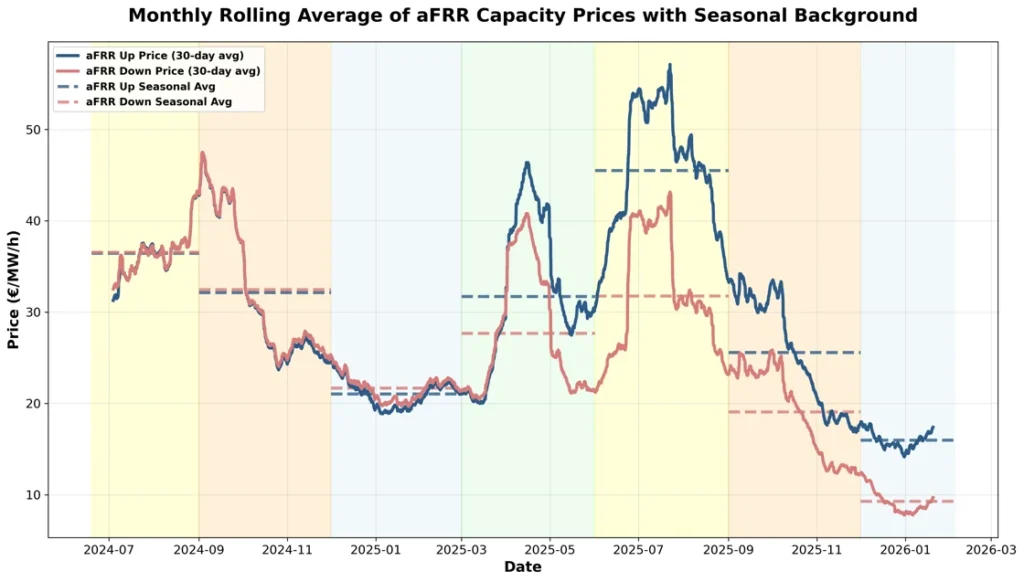
The graph below shows the rolling monthly average of aFRR prices by capacity.

Historical AFRR up-and-down capacity price time series for 2025 and 2026

The blue line shows the upward-trending monthly moving average for the aFRR, and the pink line shows the downward-trending monthly moving average for the aFRR. Prices are indeed higher in the summer than in the winter, although we should remain cautious given the limited number of observed periods.

Price Cannibalization

The graph also shows that the seasonal average for winter and fall 2025 is significantly lower than that of 2024. This trend cannot be explained by seasonality; it reflectsprice cannibalization.

Price cannibalization refers to a market phenomenon in which an increase in the number of market participants or the volume of available supply leads to a gradual decline in prices.

In practice, the certification of storage assets under the aFRR has risen sharply in recent months, with 370 MW of certified aFRR now coming from storage, compared to 163 MW of certified aFRR in October 2025, while RTE’s average demand ranges between 600 MW and 1,000 MW depending on the time of day and season. Batteries have a low marginal cost for participating in aFRR and reserves in general, and they offer low prices. The overall increase in the number of these types of providers shifts the supply curve to the right, which, according to themerit order, exerts continuous downward pressure on prices.

Explore Other Blogs

Webinar presented by Greensolver, Compass Lexecon, and StackEase: Assessing the Potential of BESS Despite Uncertainties

Crossword Puzzles

Crossword puzzles based on RTE and Enedis vocabulary

Comparison between the BESS business plans developed a year ago and their implementation.

Analysis of Seasonality and Price Cannibalization of aFRR Capacity in France
Participants and Functioning of Electricity Markets · February 27, 2027 …

Battery-Driven Bidding Strategies in Continuous Intraday Market Trading · September 10, …