

Battery-Driven Bidding Strategies in the Continuous Intraday Market
Trading · September 10, 2025 · 10-minute read
Brief on the Continuous Intraday Market (CID)
Principle
The Continuous Intraday Market allows market participants to trade electricity in near real time, enabling them to adjust their positions based on updated forecasts for generation and consumption. This flexibility is crucial for balancing the grid and integrating intermittent renewable energy sources.
Order book
The CID operates on an explicit order book system, similar to financial markets. Buyers submit bids (orders to buy at a certain price), and sellers submit offers (orders to sell at a certain price). When a bid and an offer match, a trade is executed. This continuous matching enables constant price discovery and immediate trade execution.
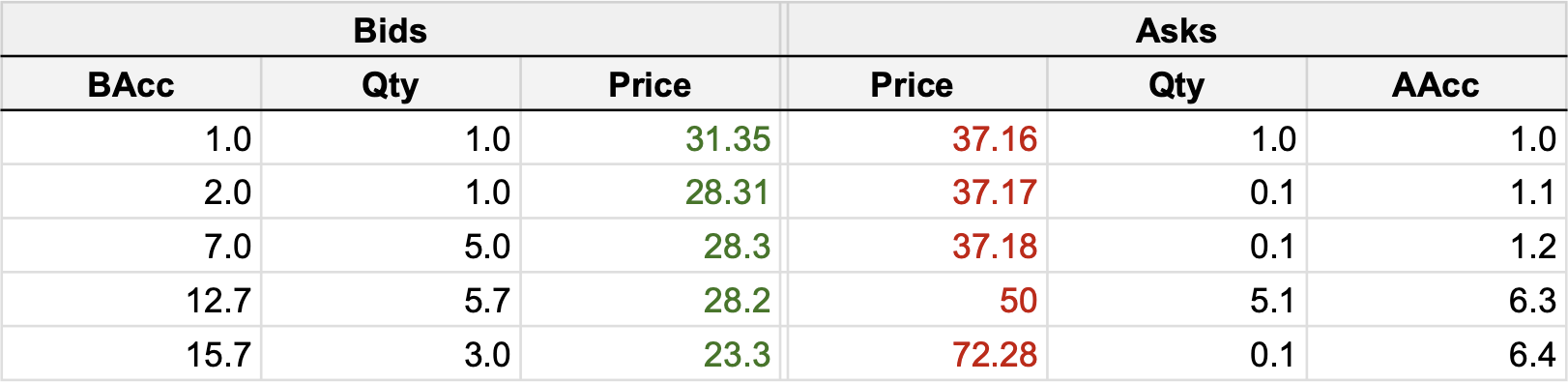
An order book for a given product (e.g., from 1:00 p.m. to 2:00 p.m.) contains a list of available bids and offers to buy or sell a certain amount of energy at a specific price. Below is an example.
Trade example
Imagine a seller offers 10 MW at €75.00/MWh. A buyer then places a bid for 8 MWh at €77.10/MWh. Since the buyer’s bid price is higher than the seller’s offer price, a trade will occur immediately. The settlement price is the price of the first order placed; in this case, it is the seller’s price of 75.00 €/MWh for 8 MWh. The remaining 2 MWh from the seller’s offer will remain in the order book, waiting for another buyer. This example is simplified; for a complete understanding of trading on the CID, please consult the full description.
Participants
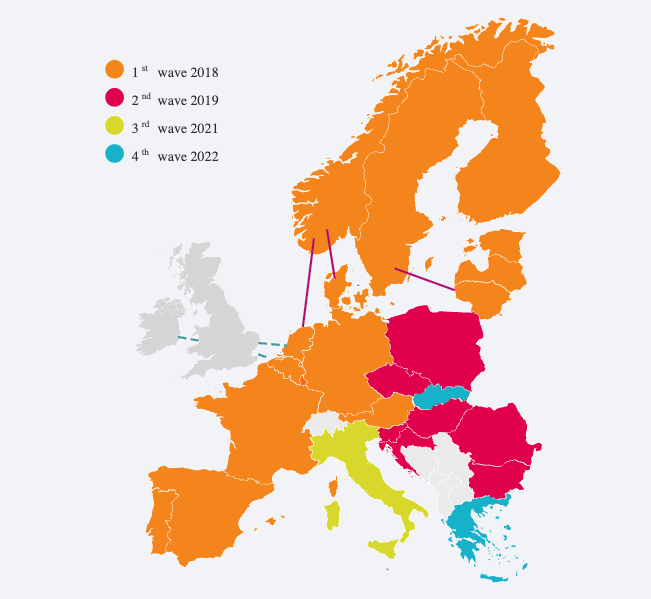
Buyers and sellers collaborate across Europe as long as the cross-border transmission lines are not congested, meaning that the orders listed in the order book are shared across many different bidding zones.
Above is a map of the countries participating in the continuous intraday trading market, known as the Single Intraday Coupling (SIDC) system. It is available on the ENTSOE website
Timeline
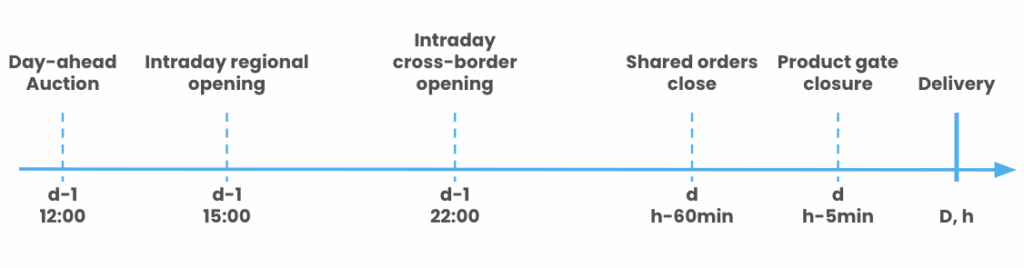
In France, the local market opens at 3:00 p.m. on the day before delivery. Cross-border orders are available at 10:00 p.m. on the day before delivery and can be traded up to 60 minutes before delivery. Local orders can be traded up to 5 minutes before delivery.
Liquidity
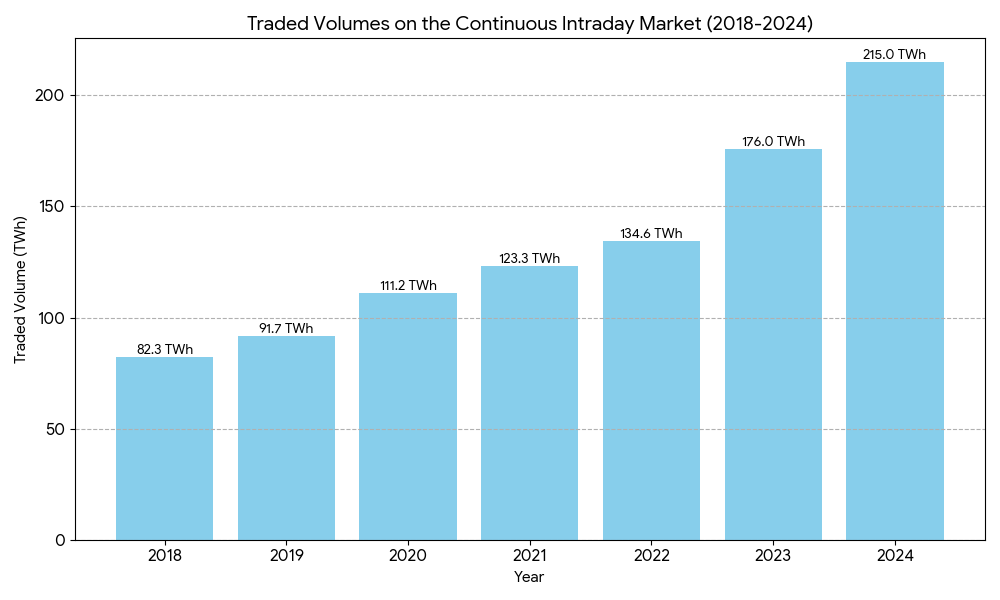
Trading volumes on the EPEX SPOT power markets increase by approximately 22% each year. Most of the trading takes place in Germany, followed by the Netherlands and then France. Detailed information is available on the EPEX SPOT website.
The volume traded on the day-ahead market in 2024 was 654 TWh, meaning that the CID accounts for about 25% of the energy traded on the power markets.
Battery Benefits
There are many ways to trade a battery’s capacity on the intraday market. This article focuses on methods that do not allow trading on the imbalance. In other words, the battery always covers the positions taken on the CID.
The general case is when the battery has already established positions, either because it traded energy on the day-ahead market or because it has already traded on the intraday market. From that point on, it can increase its existing profit in two ways that can be combined:
- Increasing revenue by buying low and selling high
- Reducing tax costs by closing existing positions or shifting work hours to lower-tax periods
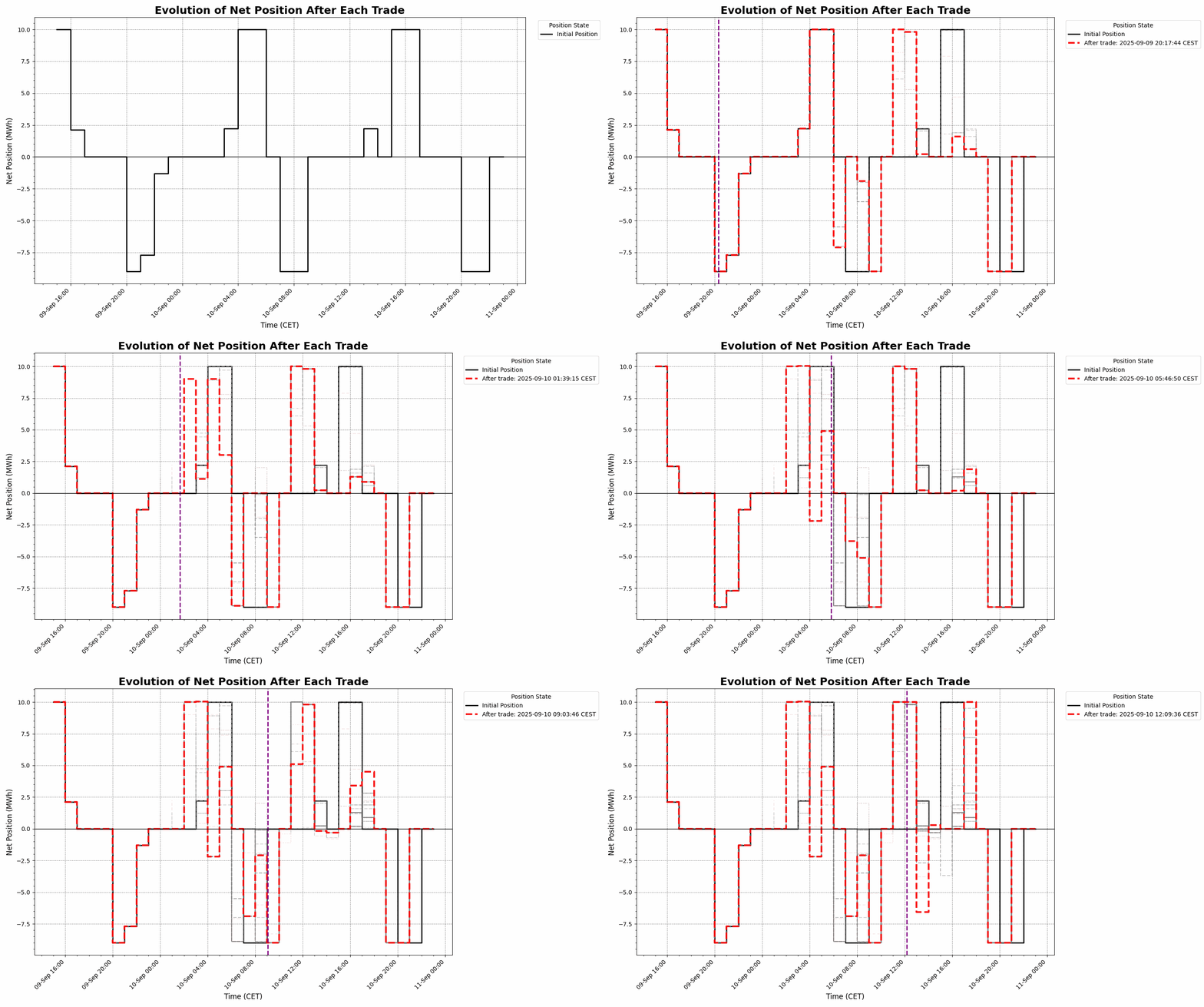
These possibilities, combined with frequent changes in the order book, allow for many trades in a single day, as shown in the illustration below.
The purple dashed line represents the time at which trades are executed; it is a simulated “current time.” The black line indicates the initial position, and the red dashed line indicates the final position. These lines change as trading progresses, indicating that a significant amount of energy is netted. Netted energy refers to a position that is opened and then closed before physical delivery: there is a financial settlement but no physical delivery.
The operations are divided into two categories: maintaining the number of cycles or changing it.
Constant cycling
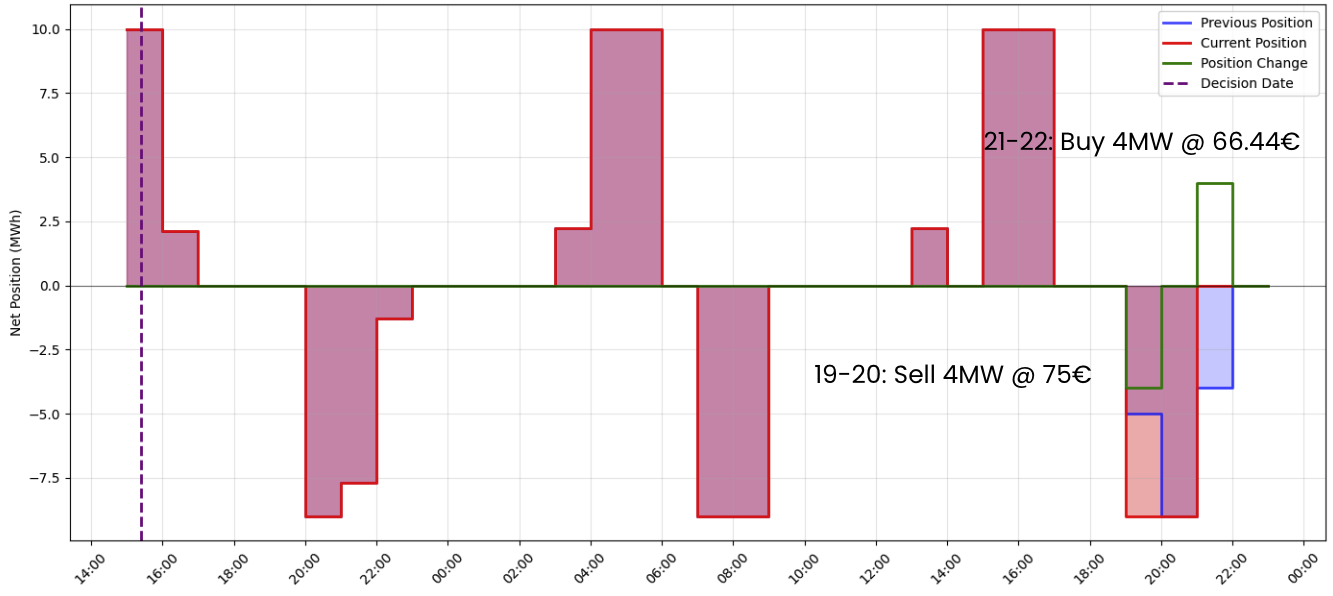
There is no change in the total scheduled power, but there is a shift in the dates on which it is generated.
In the image above, the previous position is shown in blue; most of the time, it is hidden behind the current position, which is shown in red. The operation shifts the previous position from 9:00 PM to 7:00 PM. The shift is indicated by the green line.
Adapted cycling
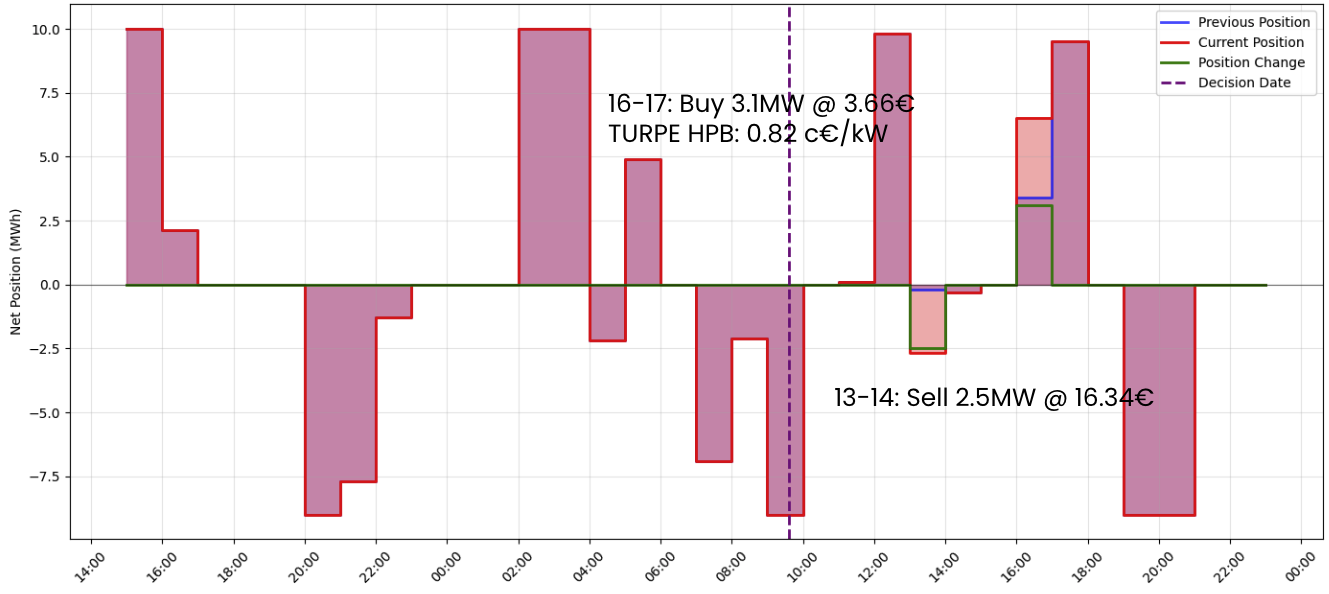
There is a change in the total scheduled power, which can increase or decrease the total number of cycles.
In the image above, scheduled power is added at 1:00 PM (additional discharge) and at 4:00 PM (additional charge), increasing the total number of cycles. Note that these positions can be canceled at a later time depending on market conditions.
Performance
A battery’s additional revenue is determined by several key factors, including its existing schedule in day-ahead and ancillary service markets, the liquidity of the continuous intraday (CID) market, battery size, and optimizer performance. The proprietary algorithms developed at StackEase are designed to process all these variables, delivering exceptional performance with a rapid optimization speed of approximately 50 milliseconds.
How do I participate in the CID market?
StackEase manages batteries in real time. We provide performance monitoring services by simulating your battery. Results are available 24/7 on a live dashboard.
We also provide aggregation services by including your current or future batteries in our balancing portfolio. This allows your company to benefit directly from the CID, as well as from ancillary services, arbitrage on supply contracts for BTM, and tax optimization through our efficient, unified cross-market algorithm solution.
Please contact sales@stackease.ai for more information.
Explore Other Blogs
Long-term revenue forecasts: market promises vs. reality
Comparison between the BESS business plans developed a year ago and their implementation.

Analysis of aFRR prices by capacity
Analysis of Seasonality and Price Cannibalization of aFRR Capacity in France
Participants and the functioning of electricity markets
Participants and Functioning of Electricity Markets · February 27, 2027 …
Battery-Driven Bidding Strategies in the Continuous Intraday Market
Battery-Driven Bidding Strategies in Continuous Intraday Market Trading · September 10, …
Index Review
Index Monthly Review Index · July 9, 2025 · 10-minute read …
How much can you earn on the day-ahead market?
How much can you make on the day-ahead market? Energy Trading …